No products
Product successfully added to your shopping cart
There are 0 items in your cart. There is 1 item in your cart.
Contemporary Painting
Welcome to our online art gallery, where contemporary art comes to life through a diverse collection of original paintings. Our commitment is to present you with surprising artistic creations that push back the boundaries of creativity.
The contemporary artists we feature can be renowned or young emerging artists, an eclecti...
Contemporary Painting
Welcome to our online art gallery, where contemporary art comes to life through a diverse collection of original paintings. Our commitment is to present you with surprising artistic creations that push back the boundaries of creativity.
The contemporary artists we feature can be renowned or young emerging artists, an eclectic choice, bringing unique perspectives and varied universes. Each work is an invitation to explore new dimensions of artistic expression. Our collection of paintings covers a wide range of artistic movements, from abstract and expressionist to figurative and hyper-realistic. We have taken care to include details on each painting visual, such as the dimensions, the support, the techniques used (oil, acrylic, watercolour, etc.) and the price, so that you can have a precise idea of your purchase. For businesses and the self-employed, under the price you'll find the minimum monthly rent for a lease purchase.
Behind each contemporary painting we offer you is a painter selected on a crush of heart. We present works from very different worlds that have moved us. From the painting that makes us smile to the one that awakens darker aspects in us, they all provoke reactions that are very personal to us. Behind each painting is a work of art that we were delighted to discover, created by fascinating artists with a rich human side. We are delighted to share their work with you. In each biography, we'll give you a sneak preview of our encounter with the artist. All the paintings presented here are available for sale online and in the gallery. You can buy your work with complete peace of mind. The online sales site is secure and the works available are updated in real time. What's more, you'll receive a certificate of authenticity for each painting purchased, which you should keep with the invoice.
Whether you're a seasoned collector or just an art lover, our gallery offers you the chance to acquire original works of art that will mark your space with their unique presence. Browse our selection, be inspired and discover contemporary art at its best.
We are proud to offer you easy and convenient access to these artistic creations. Buy online and make contemporary art an integral part of your life or come and meet us in Bordeaux. Explore our gallery today and discover the wonders of contemporary art in painting.
Please feel free to explore our site to discover our ever-changing selection of original and unique paintings. If you have any questions or concerns, please don't hesitate to contact us - we're here to help. We wish you a wonderful artistic discovery!
Painting
-
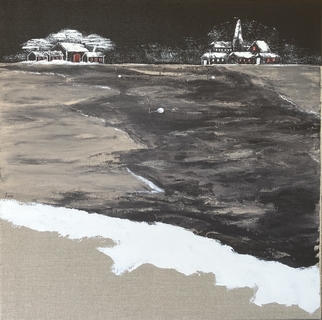
AMEY
Born in 1968, Amey is a French painter. With an unconventional background, Amey has pursued her artistic work for many years, but it was only later in life that she decided to dedicate herself fully to it. She explores a wide range of subjects, all of which share a common focus on humanity, social relationships, and nature.
Her work on monochromatic seascapes reflects what the artist seeks in nature. This familiar element is brimming with softness, strength, and serenity. The lines bring rhythm to the abstract movements of the artist, allowing each viewer to interpret and make the landscape their own. We often find in her work the inspiration drawn from the coasts of the Arcachon Basin, with its tides, sandbanks, boats, and oyster farms. Amey presents the subject in a very graphic and contemporary way, using a distinctive lighting style that is uniquely hers. The work on linen canvas allows the woven texture to show through, enhancing the natural spirit of the composition. These architectural seascapes are both poetic and dynamic.
Amey, in the Words of the Gallery
What captivated us in Amey's work is the strength that emanates from each canvas, a world that speaks of humanity and its spiritual quest through seascapes, without explicitly depicting it. Amey does not define herself as an artist; she prefers to say that she paints her emotions, with the knife replacing the pen and the canvas replacing the paper. Amey often paints in reaction to events, which allows her to vary her subjects, even though her preferred terrain remains nature. It is this very work that led us to represent her; her works are a reflection of herself, with few words but with everything essential being expressed. -
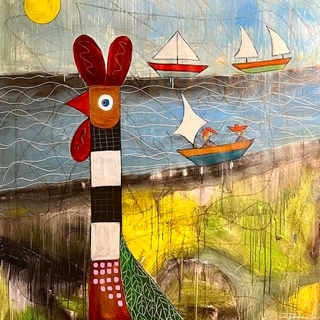
COX Viktoria
Born in 1980 in Bulgaria, Viktoria Cox grew up surrounded by colors, fabrics, and patterns that shaped her sensitivity from an early age. She quickly developed a passion for fashion design, a discipline that trained her eye for composition, texture, and the delicate art of making colors interact. Without realizing it yet, this creative environment became the silent foundation of her future artistic language.
In 2013, a seemingly simple gesture—picking up a forgotten paintbrush—opened a door she would never close again. Painting became a place of absolute freedom, a space with no patterns or preparatory sketches to restrict the natural movement of her hand. Where fashion demanded structure and precision, the canvas offered the fertile unpredictability of instinct. Viktoria paints the way others breathe: out of necessity. Layer after layer, colors collide, forms appear on their own. She quickly understands that her work will never come from a strict plan but from an inner movement.
A year later, in 2014, she presents her first solo exhibition: twenty-seven works expressing this moment of transition and creative liberation. Visitors discover a vibrant universe filled with energy, tension, and at times a touch of playfulness revealed through a detail, a contrast, or an elusive shape.
Her artistic approach soon aligns with what is known as informal painting. For Viktoria Cox, it is not a label but a way of inhabiting the world. She paints what cannot be spoken, only felt. Each canvas becomes an improvised journey, a succession of layers where spontaneous impulses form the structure. Nothing is fixed; everything remains open. Poetry, chaos, softness, and mischief coexist—just as they do in life.
Her work rapidly crosses borders. Germany, Italy, and Austria exhibit her paintings, while others join private collections throughout Europe and Japan. Everywhere, viewers recognize the same vibrant intensity and raw sincerity that have become her signature.
Today, Viktoria Cox continues to paint with the same flame that sparked her artistic path—an instinctive spark, a genuine emotion. Her works never seek to impose meaning; they invite it. They offer a space for interpretation, personal projection, and the silent dialogue that belongs only to the viewer.
In a world eager to explain and categorize everything, Viktoria Cox chooses freedom. She lets painting speak for her—and perhaps that is where the true strength of her work lies.
The Gallery’s Words About Viktoria Cox
It was while following emerging international artists that I discovered Viktoria Cox’s work. Her paintings struck me so deeply that I began following her creations regularly. With each immersion into her artistic universe, I found myself even more eager to discover what she would create next. I was captivated by her writing, her freedom, her palette, and her technical mastery. She has a world entirely her own—one that continues to fascinate me.
-
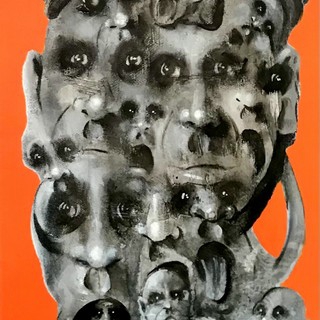
FISCHER Jean-Christophe
Born in 1971 in Saint-Dizier, France, Jean-Christophe Fischer discovered his passion for painting at a very young age. Yet, at twenty, he put down his brushes. In search of a deeper resonance with life, he turned to music and dance, where rhythm and movement became his new languages.
For more than a decade, he worked as a percussionist alongside great masters, including François Kokelaere, whom he regards as a decisive influence:“François Kokelaere made me gain twenty years of research; I owe him a lot.”
Those years immersed in rhythm, listening, and vibration silently nourished his vision. Through encounters and reflection, Fischer developed a deeply humanistic outlook on the world. When he eventually returned to painting, more than ten years later, it was with renewed maturity and an inner necessity that transformed his artistic approach.
At first, he explored abstraction, attempting to express the pulse of existence. But soon, the human figure reappeared. In the textures of paint, faces emerged — anonymous yet universal — bearing doubt, silence, and fragility.“I didn’t see it coming. It was a discovery: the material made me touch my inner resonance. Then, like a subtle analysis, I set out to meet myself… I had to explore all of it.”
From then on, the human being became his central subject. His paintings reveal a fragile, questioning humanity, full of uncertainty but also of awareness. The faces he paints seem to gaze back at us, as if seeking connection. His canvases speak of solitude and the desire for unity, expressing the intimate tension between isolation and belonging.
Fischer’s art, charged with emotional intensity, echoes the great contemporary questions — identity, memory, and the human condition.A New Era: Color, Play, and Reconciliation
In recent years, Jean-Christophe Fischer’s work has entered a more luminous and symbolic phase. His painting embraces vivid colors, playful shapes, and movement. Without losing its emotional depth, it gains a joyful, dreamlike quality where symbols, numbers, and fragments of daily life become pieces of an existential puzzle.
In recent works such as At the Center of the Game and this colorful triptych exhibited at Galerie Bouillon d’Art, Fischer explores the delicate balance between inner reflection and the vibrancy of the world. The composition features a central figure — often seated or contemplative — surrounded by a burst of symbols: stars, flowers, musical notes, puzzle pieces, glasses of wine, fragments of sky and sea. Everything seems to float in a rhythm of color and movement, as if life itself had become a great game of connection and meaning.
This new creative cycle marks a return to light. Without denying the gravity of his earlier work, Fischer now celebrates the poetic and playful side of existence. His visual language, at the crossroads of pop art, symbolism, and free gesture, sometimes recalls the spontaneity of Keith Haring, yet differs through a more introspective and meditative dimension — for Fischer, joy always carries reflection.
Painting the Human Resonance
Today, Jean-Christophe Fischer continues to work at the intersection of the spiritual and the everyday. He paints as one might compose music — seeking the perfect harmony between rhythm, color, and silence. Each canvas becomes a space of vibration, an invitation to find unity within chaos.
The Gallery’s Words on Jean-Christophe Fischer“Man is always at the center. Even in play, even in color, he seeks to understand himself.”
Even before the creation of the gallery, I was irresistibly drawn to the works of Jean-Christophe Fischer. My first artistic “encounter” happened through an art magazine — I couldn’t take my eyes off those gazes staring back at me! Disturbing, perhaps, but so utterly captivating.
In 2013, I finally decided to reach out and propose a collaboration, without really expecting him to accept. We were a young gallery, and he was already well represented and widely recognized. His “yes” was an unexpected gift — I would at last have the opportunity to share this artistic crush and represent his work.
Since 2014, I’ve had the pleasure of introducing his universe to you and inviting you to follow him through his creative journey. Jean-Christophe is a deeply committed person who values human connection above all else — a shared conviction that unites us and strengthens our collaboration.
-
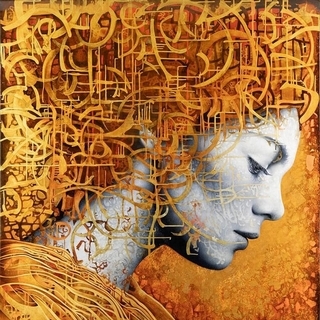
LINE.C
Entering LINE.C’s world means traversing layers — layers of color and varnish, clay and pigment, but also layers of time, body and emotion. Since the very beginning, the artist from Rennes, born in 1977, has placed the face and the gesture at the heart of her research, seeking in the human being a territory where what escapes can emerge — the uncontrollable, the tremor, the crack in the mask.
Trained at the Rennes School of Fine Arts (1996–2000), she very early explored photography and video. Her “non-mask” series — bungee jumpers captured mid-air, then exposed onto canvas — reveals a fascination for those moments when expression bursts out raw, without filters. In parallel, she develops a pictorial practice on canvas nourished by dripping and by the gestural energy inherited from Pollock, but redirecting that aesthetic toward an interrogation of the face as a porous surface, a shifting mask, a projection space for the unconscious.
A formative journey to Africa led her to discover the power of natural pigments and the question of métissage. Her first androgynous faces, exhibited at Dak’Art 98 and then at Femin-Art in Germany and Belgium, already testified to a cosmopolitan universe attuned to dialogues between techniques and cultures. In 2004, the poster she created for the Transmusicales de Rennes inscribed her research in the public sphere and confirmed the aura of an artist able to let her visual vocabulary circulate between artistic and urban scenes.
But it was in 2008 that LINE.C took a decisive turn: the discovery of lacquer. She waited seven years before contacting master craftswoman Isabelle Emmerique, who would train her in European lacquer, a three-hundred-year-old tradition whose gestures draw from China and Japan. In this slow and demanding medium, the artist found the ideal place for a dialogue between technical rigor and inner vibration. Varnishes and pigments are laid down in successive layers, feeding each other, creating unprecedented depths where light seems to circulate from within the material itself.
This technical mastery is anything but a retreat. On the contrary, it opens LINE.C to an experience of extended time, where each layer becomes a breath, a meditative interval. This dimension deepened in 2018 during an artist residency in Longzhou, China. There she discovered calligraphy with master artists and learned to consider the line not as a mark but as a respiration. The notion of “breath,” essential to East Asian thought, now irrigates her gesture: the entire body participates in the act of painting, ink or pigment extending the inhalation and exhalation, the writing becoming almost choreography.
From this experience arose her “imaginary writings.” Neither alphabet nor calligraphy in the strict sense, they constitute a plastic language where the unconscious and emotion outweigh intention. The artist begins by transcribing her inner states, then frees herself from them to allow semi-abstract or figurative forms to appear, as if emerging from a mental hinterland.
In her recent works, the face remains but sometimes fragments, dissolving into the material only to reappear anew. Pigments, lacquers, oils and calligraphic gestures intertwine to build interior landscapes where the human is no longer just a subject but a texture, a rhythm, a flow. Abstraction and figuration do not oppose each other: they coexist, respond to each other, slide into one another like the layers of varnish she patiently superimposes.
Contemplating a work by LINE.C thus means accepting a double journey. A sensory journey first, into the thickness of the material: reliefs, inlays, transparencies that reveal themselves slowly. An inner journey next, into the space of emotions and archetypes: mixed faces, unknown writings, traces of breath. Her paintings and lacquers offer an experience of slowing down in a world saturated with instantaneous images; they invite us to take the time to observe, to enter the density of pigment and light, to listen to what the hand has inscribed in the silence of the gesture.
LINE.C’s work thus stands at the confluence of multiple heritages — Western gesturality and Eastern slowness, traditional techniques and contemporary questioning — to invent a profoundly singular pictorial language. She reminds us that beneath the layers of the mask there is always a breath, a writing, a face.
The Gallery’s Words: LINE.C
I discovered LINE.C’s work in 2018 and was immediately captivated. The delicacy, the lightness, the movement, and the energy were simply incredible. At the crossroads of eras, the artist guided me toward her spirituality and inner world. Seven years later, we are reconnecting, and to my great delight, we have agreed to present her work in Bordeaux—work that, I am convinced, will touch you deeply. -
MASSCHELEIN Tony
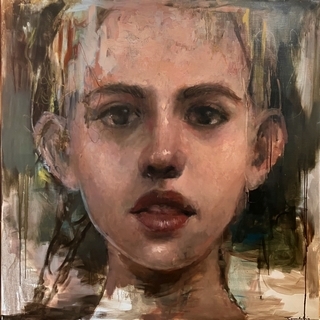
Tony Masschelein is a French painter born in Roubaix in the north of France in 1973. Since his childhood he has had a passion for the visual arts and is interested in comic books. During his college years, he learned to master the pencil through the portraits he sketched of his teachers in his school notebooks.Tony Masschelein discovers painting in museums and becomes impregnated with its mystery, the artistic part of his being does not cease to reveal itself but Tony Massechelin is also a traveller and little by little the call of new horizons is felt. He began by going to Paris where he met many people who intensified his desire to discover the world. Tony Masschelein then began to alternate his first jobs with longer and longer trips for several years. He felt a vital need to go and meet other cultures, and he discovered India, Thailand and South-East Asia in particular. The successive trips became initiatory journeys, and Tony discovered Buddhism and the path to self-realisation. Several meditative retreats in monasteries contributed to finding the rightness of his inner self. These long stays on the edge of the world, his view at a fair distance developed by a self-confidence built up through encounters, will enable him in 2005 to realise his childhood dream, the brush finally becomes his profession, he invests his studio.For Tony, painting is a game of colours, materials and lights, the subject becomes the support for an artistic expression that he wants to be free. He opens up to the work of Zao Wou Ki and his spiritual abstractions because for Tony Masschelein painting is a score, it has its own musicality and borders on an initiatory experience. He is passionate about composition, form becomes a pretext for creation. Tony Masschelin defines himself as a painter of the end of the 19th century who likes to mix writings. He creates portraits with fascinating looks that reveal the interiority of the being, question, keep the mystery, destabilize through the palette that remains the artist's guide throughout the creation:"Painting is a rhythmic interweaving of musical pages" T.MTony Masschelein has always put painting on a pedestal, it is both the mystery and the mirror of the soul, it is the invisible.Portraits, landscapes, still lifes, abstractions... Tony Masschelin forbids himself nothing, the subject is only a pretext for expression, freedom takes precedence, the composition is born, the visitor's gaze is disturbed, emotion is more than ever present.
Tony Masschelein : The gallery's words
The encounter with Tony's work came about through a colleague who was exhibiting his portrait work at the Lille Salon in 2023. Captivating...more than that, Tony's paintings are disturbing, mysterious, overwhelming. One immediately perceives an extreme sensitivity, an ability to pierce the soul buried behind faces that might seem academic and yet are not. The subsequent discovery of nudes and still lifes provoked the same sensation, a part of the intimate, the play of light, of materials in a bright palette that transport us to the heart of the subject, the gaze moves from the outside to the inside of the scene. Then the meeting of the artist, passionate and discreet, open and modest, who speaks of his painting with all his being. I am happy to share with you this favorite, which far from merging with artistic trends, puts the spotlight back on the great painters of the 19th century who would observe our contemporaries. -
MONJO Nicolas
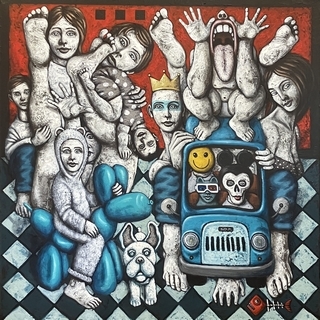
After looking for his own path for a long time, Nicolas Monjo discovered painting at the age of twenty. Selfthaught, he developed his own technique and allows him to play with the medium, offering a very personal style. The human figure is at the center of his work. His subjects often evolve in fantastic univers, and are not without any resemblance to the society and the world around us.
The characters are locked up, crushed by the frame of the painting, they present a difficulty which makes us leave our condition, of the transcendence, in a violent and anxiogenic society which does not always allow us to break free. The "dominant / dominated" relationship is often evoked and the recurring figure of fish here is the ultimate expression. A soft and dark color palette creates a unique atmosphere, the bestiare evolves from year to year. Today Nicolas Monjo has integrated very beautiful collections and his work has been noticed by art critics.
Nicolas Monjo : The words of the gallery
Nicolas Monjo contacted the gallery to present his artworks. I immediately perceived his technicality and went straight into his world. Seduced by the subject and his vision of the world, his artworks touched me. The first encounter with the artist, friendly and simple, achieved to convince me. Nicolas Monjo is genuine and sincere in his work, he does not really explain what led him to paint but recognizes the absolute necessity to create. With a true artistic soul, he prefers to stay in his studio and let others talk about his work. Nicolas brings a different touch in the gallery and joins the artists with a marked identity and a beautiful personality. -
REHEISSER Thomas
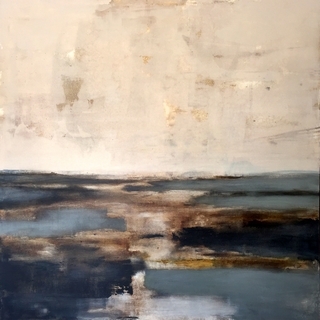
Born in 1977, Thomas Reheisser lives in a family environment that is conducive to the art he discovers as a whole. Two superb perspectives stand out for him as a matter of course: music and drawing. As long as he remembers, Thomas has always held a brush without allowing him to express himself fully. As soon as he graduated from high school, Texunion spotted his pencil stroke and recruited him, he designed for it the collections of this mythical brand until 2000, when the company closed. Thomas Reheisser then decided to resume his studies in music and became a teacher at the Mulhouse and Colmar conservatories. Passionate about the guitar, he expresses and transmits through the strings what the brush has not expressed for a long time. Then it was the shock, the trigger, he met Christophe Hohler, a famous plastic pianist. Thomas returns free, free to express through drawing, through painting. His first work, after all these years of silence, is simply breathtaking. Power, depth, maturity, Thomas has found his artistic expression.
Thomas Reheisser became known for his expressionist work, which already revealed, to those observant enough, his attraction to abstraction. He approached the material from a radiographic angle, revealing successive layers, scratched, foregrounding transparency and texture. In 2023, his move to the south of France became a catalyst; he began painting marine landscapes using earth pigments, thereby anchoring his work in reality. Timeless, sublime, and introspective, Thomas's compositions are illuminated by inks and contrastsUnable to match it, we will quote Lionel Bamond, writer, discovering Thomas' works "Impossible to control the emotion by punching the stomach... In the hollow of these wandering and gushing creatures of a night of carbon, I guess, pell-mell, the blurring of Jean-Jacques Henner, the lighting of Caravaggio, the ink of Soulage, the solitude of Bacon".
Thomas Reheisser : The gallery’s words
3 photos in an email and a modest, almostshy presentation. Thomas Reheisser contacted me, a name I will never forget. The first visual haunts me, the second captivates me, the third decides me. Our exchanges are simple, the artist is in line with the message, modest, simple and generous.
2021, exhibition
2024, exhibition -
RONEL Christophe
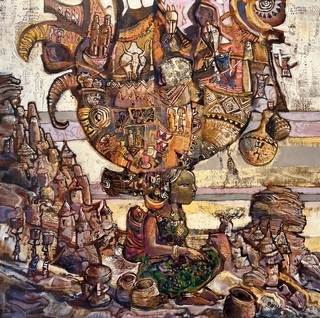
Christophe Ronel was born in 1964 in Rouen, Normandy. In a city imbued with painting, he had the privilege of growing up alongside his father, the landscape painter Marcel Laquay. Thus, from a very young age, Christophe Ronel absorbed this medium which he would never abandon. At the age of 10, he began to showcase his first paintings, and by 14, he was participating in collective exhibitions at the Rollin Gallery in Rouen, which also exhibited his father’s works. Then, at 17, the gallery offered him his first solo exhibition, an event Christophe speaks about with great emotion.
His exhibitions unfolded naturally, from Parisian salons to the Salon des Artistes Français at the Grand Palais, where he won the Gold Medal and the Grand Prize in 1993. Subsequently, his encounter with Suzanne Tarasiève, a prominent gallerist from Barbizon, proved to be decisive, marking the start of a collaboration spanning over 18 years.
An agrégé in fine arts, Christophe Ronel has also been teaching since 1990 at the École Nationale Supérieure des Arts Appliqués et Métiers d'Arts Olivier de Serres in Paris. The artist divides his time between his studio, the school, and travel, a rich combination that complements each other and serves as a source of inspiration.
Christophe Ronel began with landscape painting under the guidance of his father, then his work gradually traversed the influences of Fauvism, Expressionism, and the CoBrA movement, all under the influence of the free figuration of the late 1980s. From the early 1990s to 1993, large formats appeared, art brut came into play, the palette narrowed, and writing made its entrance, a path began to take shape. From 1993 to 1994, underlying figuration resurfaced but in a different way, and writing evolved. It was in the mid-1990s that the “Ronel spirit” took form, an artistic style nourished by travel, literature, and encounters. The artist would say that "the ultimate goal remains painting," with subjects posed, everything is yet to be done. Thus began a work of internalization, interpretation, and recomposition to recreate an artistic whole where narration takes the lead.
Christophe Ronel loves to be surprised, to seek out possibilities, to explore new compositions, to make shifts. He blends places, cultures, objects, everything is infinitely reinvented. What is less known is the importance of literature and words, which are inseparable from the creative process for the artist. The story continues from painting to painting, even incorporating the title of the work into the heart of the material. Books hold great importance; Christophe spontaneously cites "Invisible Cities" by Italo Calvino, "My Name is Red" by Orhan Pamuk, as well as the literature of the Maghreb and Japan, entire worlds to discover, cultures to explore, words and calligraphies to master.
For over thirty years, more than one 120 solo exhibitions have been dedicated to him, both in France and abroad, in galleries, cultural centers, and museums in Paris, Lille, Amiens, Le Touquet, La Baule, Rouen, Barbizon, Brest, Chartres, Grenoble, Lyon, Montpellier, Nice, Saint Jean De Luz, Saint Malo, Brussels, Casablanca, Marrakech, Sousse, Hanover, Palm Beach, Singapore, and Tokyo. His paintings have notably been exhibited at the Château de Vascoeuil, the Abbey of Cercanceaux, the Palais Bénédictine of Fécamp, the Hôtel de Région in Rouen, the Archives of Chartres, the General Council of Seine Maritime, the Brittany Ferries collection, and at museums in Nice, the Bourdelle Museum in Paris, the Postal Museum in Paris, the Fine Arts Museum in Le Havre, Louviers, Châteauroux, Chartres, Brive, Aix-en-Provence, Girona, Sarajevo, Shanghai, the Art and Culture Center in Taegu, Korea, the Museum of Sarria, Spain, in Japanese museums in Matsumoto, Fukuoka, Nagano, the International Forum in Tokyo, the Aoyama Spiral Hall in Tokyo, the National Museum of China in Beijing, and the National Chinese Museum in Tianjin, as well as the National Museum of Taiwan.
Collections:
• Musée de Nice
• Fondation Compagnie Générale des Eaux
• Ville de Boulogne-Billancourt
• Conseil Général de Seine Maritime
• French Cultural Centers in Casablanca and Marrakech
• Museum of Sarajevo
• Brittany Ferries Company
• Cap Gemini
• Fondation Plage pour l'art
• Liquitex Laboratory, Le Mans
• Musée Daubigny, Auvers sur Oise
• Fondation OVALTO
Private Collections: France, Belgium, Netherlands, Germany, Austria, Switzerland, Italy, Morocco, Lebanon, United States, Mexico, Australia, Brazil, China, Singapore, Japan, United Arab Emirates
Awards and Commissions:
• 1991: Prix Arletty, selected for the endowment
• 1992: Invited to the Grand Prix of Contemporary Art, Monaco
• 1993: Gold Medal and Grand Prix at the Salon des Artistes Français, Paris
• 1994: Selected for France-Japan, exhibited in 12 cities in Japan organized by L’Oeil magazine and Nippon Television
• 1998: Commissioned to paint the “Jules Verne Trophy” for Cap Gemini, Paris
• 2004: Rugale Michailov Prize from the Taylor Foundation
• 2010: Guest of Honor at the Vincennes Salon
• 2012: Invited to the Biennale Off, Park Hyatt, Al Maaden Golf - Marrakech
• Monumental works at the Marrakech Biennale, headquarters of the Alliances group, Casablanca
• 2014: Guest of Honor at the Salon des Artistes du Marais - Mairie de Paris - 4th arrondissement
• 2015: Guest of Honor at the Puls’Art Festival - Le Mans
• Created a 40 m² ceramic mosaic mural for the Moroccan Ministry of Culture - Historical Documentation Center of Essaouira
• 2018: Invited to the Kunst Doc Contemporary Art Festival in ULSAN - South Korea
• “Tribute to Marcel Duchamp” - Homage to the Norman ready-maker - Galerie de l’Hôtel de ville, Rouen
• 2022: Adolphe Gumery Prize from the Taylor Foundation awarded to a traveling painter
Christophe Ronel : Words from the gallery
It was 15 years ago, and I haven’t forgotten. While visiting the Lille Art Fair, I discovered Christophe Ronel’s paintings around a corner. Intrigued, I approached and entered this dreamlike world, losing myself in it. All my comings and goings brought me back to his work. Fifteen years later, and to my great delight, we are finally working together. It is an emotion as fresh as the first day that I wish to share with you.