No products
Product successfully added to your shopping cart
There are 0 items in your cart. There is 1 item in your cart.
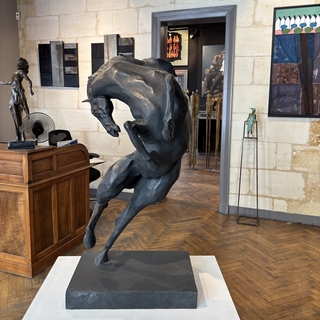
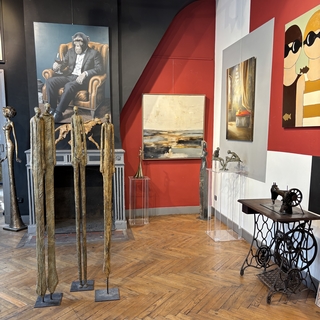
Buy a sculpture: Awaken your Senses through Sculptural Art
Let yourself be enchanted by the magic of sculptural art by exploring our exceptional collection. If you're looking to buy a sculpture that inspires wonder and awakens your senses, you've come to the right place. Our sculpture website offers you a unique experience in discovering and own...
Buy a sculpture: Awaken your Senses through Sculptural Art
Let yourself be enchanted by the magic of sculptural art by exploring our exceptional collection. If you're looking to buy a sculpture that inspires wonder and awakens your senses, you've come to the right place. Our sculpture website offers you a unique experience in discovering and owning works that transcend the boundaries of creativity, and is a continuation of the gallery that has been established in the heart of Bordeaux since 2009.
Why choose our selection of sculptures?
1. Artistic Diversity: Our collection embraces a range of styles, from bold contemporary sculptures to more classical and timeless works. This wide range will appeal to all artistic sensibilities.
2. Originality of Materials: We believe in artistic exploration. That's why our selection features sculptures made from a variety of materials, including metal, bronze, ceramics, wire and clay, as well as the artists' own compositional materials, the secrets of which remain closely guarded.
3. Emotional Impact: A well-chosen sculpture has the power to provoke intense emotions. Our collection includes works that capture the imagination, provoke thought and add an emotional dimension to your space.
4. Artistic expression: Each sculpture is a unique expression of its creator's artistic vision. To own one of these works is to enter into communion with the soul and spirit of the artist.
5. Simple buying process: Our online sales platform is user-friendly and makes buying a sculpture very simple. Browse the works, explore the details and purchase the piece that speaks to your heart in just a few clicks. You can buy a work of art with complete peace of mind, as our website is secure and the works available are updated in real time.
Experience Authentic Sculptural Art
Buying a sculpture on our online sales platform is more than just a simple purchase. It's an invitation to explore your relationship with art, expand your aesthetic horizons and create a space that exudes creativity and personal expression.
Dive into our collection today and discover sculptures that transcend the limits of time and space. Own a piece that reflects your passion for sculptural art and add a visual and emotional dimension to your world. For us, every artistic encounter is unique.
We hope you enjoy your artistic journey!
Sculpture
-
ARTIGAS PLANAS
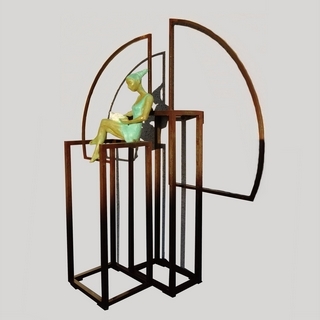
Artigas Planas is a Spanish sculptor who was born in 1960 and graduated in Fine Arts in 1985. For many years he was a teacher at the Barcelona College of Art and an artist. Today, he is retired from teaching and devotes himself solely to sculpture. His figures glide, dream, look, listen, rest or cry, but never fall from their pedestals. The 'woman' is reproduced ad infinitum, because she is infinity, the artist tells us. Artigas Planas gives her pride of place, combining colours ranging from blue-green to black. For the artist, composition is not limited to bronze, it goes beyond that and occupies a wider space in his universe. Artigas Planas situates his work in space, in the material, by creating pedestals in corten or metal with a rusty patina, sometimes imposing but always harmonious. From wall sculptures to pedestals, the artist never tires of creating.
Artigas Planas has been included in numerous collections, and continues to have a presence in Spain, as well as in Denmark, Norway, Germany, Belgium and France.
The artist created a monumental sculpture for the town of Talence, which can be seen at the entrance to the new Halles, see the sculpture.
Artigas Planas : The gallery's words
A few years ago, I was facing Joan's sculptures at a show in Nîmes. Seeing that my eyes did not leave his stand, the gallerist who represented him came to talk to me about his work and offered me to introduce me the artist who was to come on the show. It only took us a few minutes to establish this bond of trust that characterizes our relationship. Since 2012 Joan's "little ladies" live in the gallery and make the happiness of our customers. A beautiful recognition for this artist who will see in 2018 one of his sculptures, represent the city of Talence through "City envy". His monumental sculpture will welcome you at Les Halles de Talence (33). -
BERTHAUD Patrick
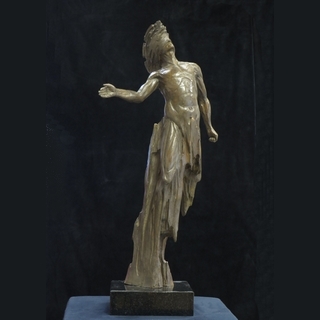
Patrick BERTHAUD is passionate about sculpture from an early age. He was received as a Companion Sculptor on Stone in 1998 and worked on cathedral sites, a great experience that continued to fuel his passion for sculpture. His various experiences lead him to master many materials such as bronze, resins, stone and terracotta. Patrick Berthaud continued in this direction and created his workshop in 2001.
The artist then made many public commissions but also reserved time for his creation and for training, former Companion he kept in him the importance of transmission.
Patrick Berthaud's artistic universe revolves around his questions about human nature, its strengths, weaknesses, emotions and limits. Works that carry messages. A recent work on the series "Les Labyrinthes" reveals all the mastery and power of the artist.
Patrick Berhaud : The gallery's words
Patrick Berthaud was traveling to Bordeaux when he came to visit the Gallery. He felt in harmony in the artistic universe that we represented and discussed with Juliette a possible collaboration. My first meeting with the artist was his portfolio that he gave us.When I discovered "Contact", the crush was immediate. From this sculpture emanates a surprising power that freezes the moment. Patrick Berthaud realizes many monumental sculptures, he masters his art without losing emotion and sensitivity. After a few exchanges, we agreed together on a first introduction of his works in the gallery. -
BORGHI Pascal
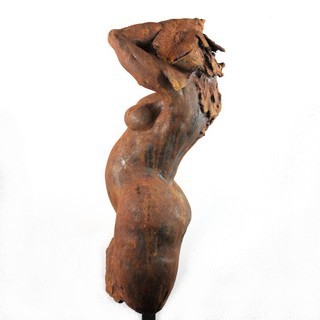
Pascal Borghi is the memory of a past, the witness of an era. At a very young age he joined the army and spent 2 years in Lebanon in the middle of the civil war. Barely 20 years old, he will keep indelible traces of this period and the intimate conviction that it must serve to denounce and become aware. In 2001, when nothing prepared him for it, he discovered the land. His fingers touch and plunge into the matter, a sensation he will never forget. Inevitably bodies appear from his hands, recounting this painful past but also paying tribute to man's resistance. Pascal Borghi learns to tame matter. With time and practice, he will extract the essential from it. His work is raw, no frills even in the supports. His works in stoneware or bronze are generally planted at the top of a stem as an elevation of the body towards a better world. All the strength of the artist lies in his sincerity and humanity. Each work is visceral, indispensable.Pascal Borghi : The words of the gallery
First it was an email I received a few years ago that caught my attention. Pascal was contacting me on behalf of a confrere. I was captivated by the strength and conviction of the works presented, but it was only later that we got in touch again. The work had evolved further, we were getting to the essential, to the irreducible sculpture. Pascal came to show me his works in the gallery, a feeling that comes from deep within, this is what the artist had just offered me. I listened to the artist talk to me about his life, his feelings, his sincerity and his simplicity conquered me.
2022, exhibition
2025, exhibition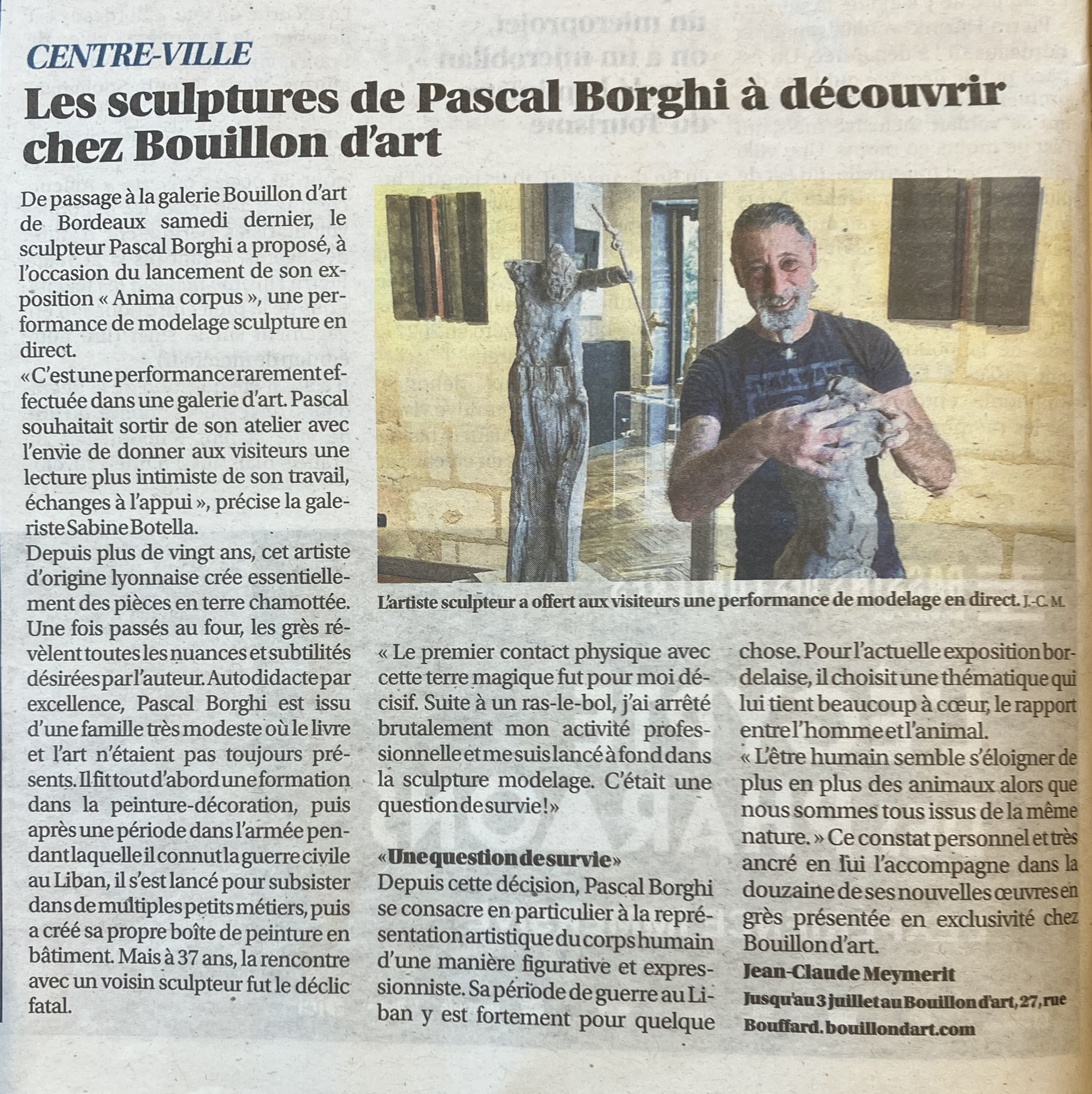
-
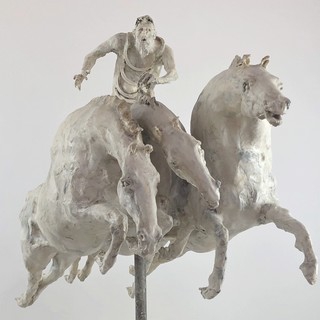
CARR-ORTOLAN Val
Artist in the depths of herself Val Carr-Ortolan, born in Gabon in 1965, started with painting, her first love, to finally reveal herself through sculpture more than 20 years ago.It is in 2005 that we discover for the first time her work. A very marked artistic identity in which power, strength and softness intermingle inviting the hand to touch, feel, perceive the intention of the artist.Val makes us rediscover sculpture through her favorite material, paper. Works of art that are delicate and imposing at the same time, with soft and sober patinas that fully restore the artist's intention.Val Carr-Ortolan works on two themes of predilection : man and animal, separately or constituting the inseparable duo of the story she tells us.In 2013, Val Carr-Ortolan obtained the second special mention of the jury at the 11th International Biennial of Sculpture in Rambouillet, in 2016, the second prize for sculpture and the Univers des Arts prize at the International Academy of Arts in Paris.In 2017, she wins the artists' prize and the public's prize at the Carrara Trophy held at the Saint-Lô National Stud Farm.
Discover the 2024 exhibition at the Bouillon d'art gallery in Bordeaux
Val Carr-Ortolan : The gallery’s words
I discovered Val's work at an art fair, where she presented some of her most captivating works. A marvel, a treasure, the hand involuntarily slips on the work, the touch becomes extraordinary and the sensuality of the work and the material reveals itself as a matter of course. I acquired one of her works to offer it to someone very dear to me, the magic of the work worked, the emotion spoke, a moment I will never forget. The encounter with the artist was just as natural and we decided to work together. -
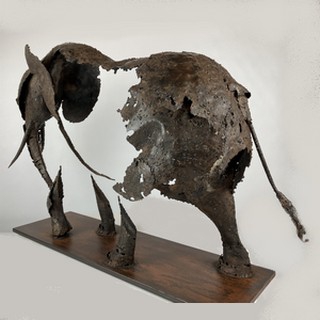
CHESNEAU Pascal
Pascal Chesneau, born in 1967 in Brittany, chose a completely different professional path than the one he is known for today by training as a boiler maker and pipe fitter. After a few contracts in the early 2000s, he decided to complete his knowledge of materials and trained as a cabinetmaker. Pascal then imagined himself as a wood sculptor but the town of Lisieux commissioned him to create a work in metal to be placed on a roundabout, the metal caught up with him!In 2014, he won the Wildlife Artist of the Year award from the prestigious Shepherd Foundation in London, which was the real trigger for his career. Pascal Chesneau is very involved in the protection of endangered species and has been working with the Foundation since that time. In addition to the desire to give transparency and lightness to the metal, one can also see in it the symbol of these endangered animals.The artist hunts down car parts, bonnets and roofs to give them new life by chiselling them like lace. Wild animals are born between his expert fingers, a few lines, just the necessary and the eye will do the rest.
Awards :
-Rosini Award, Snaa Bry sur Marne 2013 -
-Wildlife Artist Of the Year Award, David Shepherd Foundation 2014
- Silver Medal, Salon des ---Artistes Français, Art Capital 2014
-Estades Award, Snaee Bry sur Marne 2015
-Taylor Foundation Award, Salon des Artistes Français, Art Capital 2015
The gallery's Words
I have known Pascal Chesneau's work for several years, I like his agility, his magician's hands which, from a hard and opaque material, manage to sketch a light and fragile silhouette, to enhance the power and fragility of animal species. It is with great pleasure that he joins the artists of the gallery. -
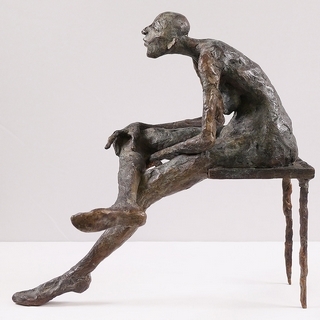
CHEUVA Chantal
Originally from Northern France, trained at the Beaux Arts of Lille and Roubaix, she is a sculptor since the age of 20. C. Cheuva works in a urge a sculpture close to Expressionism. Her signature remains powerful and spontaneous.More recently, she directs her creations in patinated plaster, and bronze.Year-round, she runs a live model workshop as well as internships and theme weekends.Present in numerous personal and collective exhibitions, her work is presented in gallery and international art fair.Her artworks evokes the life of everyone, of a generation. This universal subject confronts us with an disturbance but a profoundly true reality. The artist invites us to react, reflect, and put an end to this passivity to become truly actors in our society.
The gallery's words
I discovered the work of Chantal Cheuva on a show in Lille, her sculptures were a few meters from me, and captivated me. A very beautiful energy emanated from this work and the presence of these "women on the move" became addictive. A few months later, the artist contacted me to offer me a collabration. I then discovered an artist of great sensitivity, very attached to the human relationship. I had the great pleasure of counting her among our artists and presenting her in Knocke, Belgium, before introducing her work to Bordeaux.
-
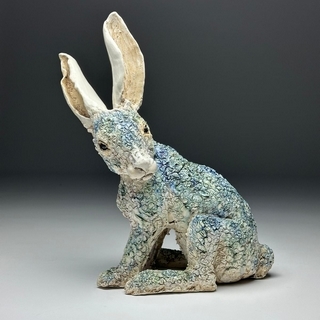
DAEFFLER Barbara
Barbara Daeffler: Sculpting the Memory of the Living World
Among the contemporary artists redefining ceramic sculpture today, Barbara Daeffler occupies a distinctive place. Her work exists at the crossroads of archaeology, mythology, and the natural world. Through a powerful and poetic bestiary, she creates sculptural forms that seem to emerge from forgotten eras, as though unearthed from ancient civilizations and reawakened in the present.
Born in Saint-Louis, France, in 1973, Barbara Daeffler lives and works in Langueux, Brittany. Her artistic journey has been shaped by two lifelong passions: observing wildlife and exploring the traces left behind by ancient cultures. Educated in art history, archaeology, and ethnology at the University of Strasbourg, she developed an early fascination with the profound relationship between humans and animals across time and civilizations. This question continues to inform the essence of her artistic practice today.
Her discovery of ceramics came naturally through archaeological excavations and specialized training in traditional ceramic techniques. Over the years, she deepened her understanding of clay as a material capable of carrying memory, history, and emotion. Before dedicating herself entirely to her artistic practice, she taught modeling and sculpture within a Centre for Fire Arts in Brittany. In 2018, she established her own studio, marking the beginning of a fully independent artistic career.
Barbara Daeffler’s universe is populated by enigmatic creatures that are at once familiar and mythical. Mammals, birds, and hybrid beings emerge from her imagination like fragments of an unknown paleontology. Their forms often appear incomplete or weathered, evoking archaeological relics discovered beneath layers of earth. Yet these sculptures are far from static remnants. They possess a remarkable vitality, as if time itself had shaped them without diminishing their presence or strength.
Materiality plays a central role in her work. Daeffler primarily uses grogged stoneware, pushing clay to its physical limits in order to reveal its expressive potential. Cracks, fissures, erosion marks, and irregular surfaces become essential elements of the sculptural language. These rough textures are softened by porcelain, enriched with oxides, pigments, and subtle glazes, creating a compelling dialogue between fragility and resilience, refinement and rawness.
The passage of time is one of the recurring themes in her work. Her sculptures often bear the marks of fossilization and transformation, as if they had survived centuries of geological evolution. Some take the form of monumental totems, reaching heights of several meters, while others suggest intimate relics from a vanished world. Together, they invite viewers to reflect on humanity’s place within the broader continuum of life.
Daeffler’s creative process is deeply connected to the landscape. She frequently incorporates collected materials such as clay and sand sourced from specific environments. These materials become carriers of place and memory, preserving a subtle geography within each work. Through fire and transformation, the sculptures embody both the physical substance of the earth and the invisible narratives embedded within it.
Since opening her studio, Barbara Daeffler has exhibited extensively in galleries, fairs, and major ceramic and sculpture events throughout France. Her work has been presented at Art Capital – Salon des Artistes Français in Paris, the Nantes Ceramic Encounters, the Rambouillet Biennial of Animal Sculpture and Painting, and Les Arts du Feu in Rennes, among many others. In 2024, she was awarded the First Prize for Sculpture at the Salon de Printemps in Carquefou, further recognizing the originality and excellence of her artistic vision. She is also a member of Ateliers d’Art de France.
Through her sculptures, Barbara Daeffler invites viewers to reconnect with the mystery of the living world. Her works are not merely representations of animals; they are fragments of imagined histories, poetic fossils, and contemporary myths. Situated between archaeology and imagination, materiality and spirituality, her creations open a contemplative space where nature, memory, and art converge.
Barbara Daeffler: The Gallery's Perspective
When Barbara Daeffler first introduced me to her work in 2025, I was immediately captivated by its archaeological resonance, its profound dialogue with time, and the sophistication of her material language. Her sculptures inhabit a unique territory where memory, matter, and imagination converge.
Our conversations proved as enriching as the work itself, revealing an artist of remarkable sensitivity and intellectual depth. It soon became evident that her singular vision would naturally find its place within the artistic program of Bouillon d’Art Gallery.
We are delighted to present Barbara Daeffler's work and to share with collectors and visitors the poetic power of her extraordinary sculptural universe.
-
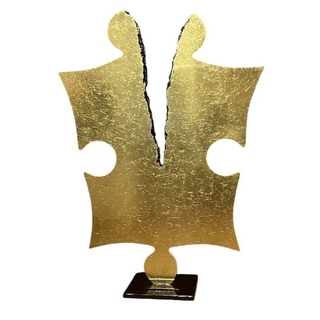
DELBERGHE Fabian
Born in 1988, Fabian Delberghe embodies the essence of an artistic journey shaped by the diversity of his experiences and a relentless pursuit of excellence. Before achieving the artistic renown he enjoys today, Fabian built his foundation through unique life stages: professional sports, the artisanal discipline of working alongside Compagnons du Devoir in cabinetmaking, and mastering second-fix trades. These varied experiences instilled in him precision, patience, and respect for materials—essential qualities in becoming the accomplished artist he is today.
Early on, Fabian made his mark in the field of renovation and the design of architectural rehabilitation projects. His clients saw in him not only a talented artist but also a trusted advisor, capable of understanding their needs to shape spaces that are both functional and aesthetically pleasing. Passionate about architecture, sculpture, and aesthetics, he understood the importance of living in a harmonious environment. At just 24, he founded his own company, quickly moving into luxury projects. This company became the breeding ground for his creativity, allowing him to experiment and refine his work with materials like wood and plaster.
It was during a project at a client’s home that Fabian encountered an artistic revelation: faced with a tree, he felt a creative impulse, a desire to transform and transcend the material. He began sculpting, reassembling, and creating curves, giving birth to his first artwork, which was soon exhibited. This moment marked a turning point in his career. In 2023, following this new path, Fabian created his first puzzle piece—an artwork rich in symbolism. For him, the puzzle represents society and the place each individual must find within it. Each piece is unique, like each human being, and the ultimate purpose of existence is to discover one’s rightful place within this complex whole. Through these puzzle works, Fabian explores universal themes such as human relationships, life in society, and complementarity, and he speaks of "assembling life paths."
Fabian chose staff as his preferred material, paying homage to the nobility of historical works like the rosettes that adorn monuments. Staff offers him an ideal playground for exploring shapes, focusing on details, and meeting the high standards he sets for himself. Locked away in his studio, he dedicates himself to his craft, constantly perfecting his techniques. After numerous trials, he discovered reverse metal paint, a medium that enhances transparency and enriches his works with an almost mystical dimension. Each creation thus becomes a technical and artistic challenge, a play of shapes and textures where ideas endlessly flow.
Today, Fabian Delberghe is recognized for his ability to fuse traditional craftsmanship with contemporary creativity, producing works that resonate with depth and complexity. His art invites us to reflect on the individual’s place in society and the harmony that each of us, in our own way, seeks to attain.
Words from the Gallery about Fabian Delberghe
I discovered Fabian’s work through a friend, and I immediately noticed his overflowing creativity and the profound emotions hidden beneath his very contemporary pieces. I then reached out to Fabian, who came to meet me for an introduction. Fabian Delberghe is a real powerhouse; ideas flow, projects abound, and his passion is palpable. His direct approach and enthusiasm made me eager to support him, and we quickly incorporated his sculptures into the gallery.
-
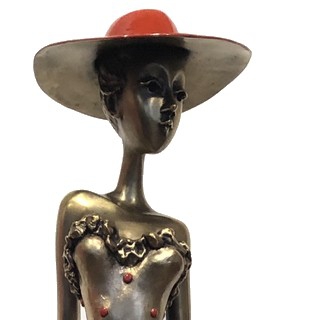
DE SUTTER Chantal
Born in 1959 in Etterbeek, Chantal de Sutter has been attracted by art since she was young. Her encounter with her future husband, Robert de Sutter, will be a decisive event in her life. Both of them being passionate by sculpture, they created an art foundry and craft the lost wax works of other artists. There was only a few step to go before working on their artistic creations. Chantal has explored very different universes letting her imagination wonder into childhood but also to women and their femininity. Her work has been so successful that the artist has not been able to continue her work of foundry and after 20 years to oscillate between foundry and workshop, Chantal has been exclusively devoted to her artistic creations. Present in the largest gallery the artist enjoys a good reputation.
Chantal de Sutter : The words of the gallery
At first I discovered her childish universe, with colorful balloons, children pointing their noses to the sky, horses straight out of the imagination. Chantal created a magical atmosphere that attracted attention. Then I discovered over the years new artworks equally interesting, characters, slender, refined and sensitive, which highlight femininity and elegance. -
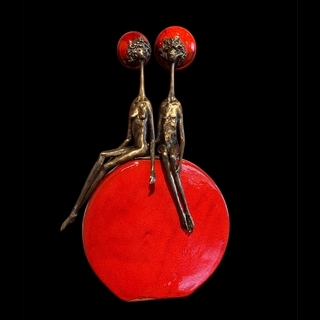
DE SUTTER Robert
Robert De Sutter, Belgian sculptor born in 1957 in Forest, son of Clement De Sutter jewelrt designer and founder lost wax and small son of the painter Ernest De Sutter, inevitably fell into the world of art. He studied arts and crafts in Brussels in the 70s and refines its training alongside great artists like Rick Poot, Jef Vanturenhout, Pierre Caille, Olivier Leloux...and working different materials : bronze, stone, earth and wax.
In 19777 he met Chantal De Block and both cdreate a foundry lost wax in which they perform the bronze works of many artists. After 20 years of experience as founders, they decide not to devote more than to their own creations. Stylish and refined, the caracters of Robert displayed great restraint. The bronze stretchand settle in breaks of rare elegance where the line and the curve play an essential role, wearing shell, ostrich egg, colored ceramic that cannot fail to emphasize the intrinsic beauty of his work.
Robert de Sutter : The gallery's words
The work of the artist was presented to us by an artist's agent. I was immediately seduced by Robert's "unreal" universe. Figures with simplified silhouettes, simple attitudes, bodies in conversation. The bronze and ceramic alliance brings softness and serenity, an atypical universe that we wanted to share with our collectors. -
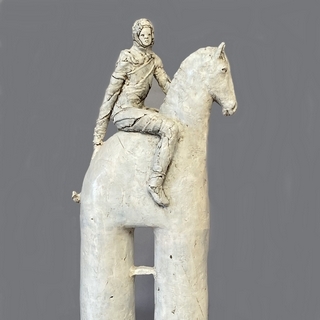
DUPIN-SJÖSTEDT Elisabeth
The human being is the main subject of Elisabeth Dupin-Sjöstedt's work. This slender bodies, with suggerated shapes, are in a moving position or static. Their detailed faces reveals a mysterious personnality.
The artist transports us in different times, past or future, real or fantasized.
Clay, faience or sandstone, allors the artist to give life to the characters. Fabric, wood, or even sand are sometimes mixed with the clay. The artist lives in the Val de Marne, in France, and studied at the famous Ecole du Louvre, in Paris. She has won numerous awards. Elisabeth proposes a walk through singular worlds, and makes us want to imagine new ones, populated by her mystical creations.
« How to deal with our world, if it’s not with the body we live in. Thanks to it, we can see, feel and find out this multiple and magical universe. The faces and the characters I create in clay allows me to explore even more the material but also its essence. While I work on a face, I expect somone to appear. Whenever ot occurs, the spirit and the material get then mixed together, that’s when it makes sense.
Here’s the duality I try every time to define and reunite.
Through this quest, lots of faces and characters come out./ We can’t say wich counrty, which erat hey belong to. But what they have in common is this mysterious humanity, endlessly moveing and animated by the invisible. » Elisabeth Dupin-Sjöstedt
Elisabeth Dupin-Sjöstedt : The gallery's words
We often look for new artists, but they sometimes show up to us. Elisabeth Dupin Sjöstedt came to the gallery during a stay in Bordeaux. She felt in her environment and spent time discovering the work of other artists. After a few exchanges she introduced me to her work. Not only did I really appreciate the person, but the discovery of the work was just as interesting. The decision to work together was obvious. Elisabeth has a very sweet universe, in which we feel good immediately. Faces, couples, made of porcelain, express a great delicacy. Elisabeth has brought a touch of sweetness to the gallery and it is always with great pleasure that we discover her new works. -
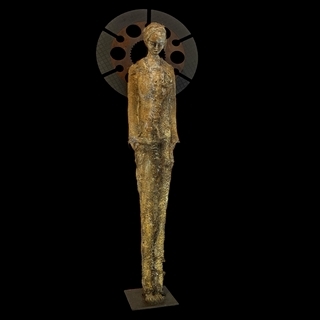
FERNANDO Béatrice
Béatrice Fernando first studied art history before dedicating herself to sculpture. Working the material seems to be a vital need for her, as she gives life to her creations.
Her works are made of a unique material, melting sand, ceramic and sandstone. it allows her to create slender silhouettes with expressive facial features and a raw look. Béatrice poses on the mankind her piercing eye, probing deep inside every human being. Well represented on the market, she exhibited in several renowm locations, including one of parisian's most prestigious gallery, on boulevard Saint germain.
She received the bronze medal of Arts, sciences, and Letters in Paris in June 2010. In 2011, she won the gold medal at the 13th international salon of Pezenas.
Béatrice Fernando : The gallery's words
Beatrice Fernando introduced me to her world several years ago. Back then, I had already been fascinated by her work that revolved around bullfighting. In 2016 I crossed it on an art show with new subjects that corresponded more to our artistic orientations. Reserved and friendly, Beatrice has accepted our collaboration proposal and since we are pleased to represent her work. Beatrice has her own world but also a technique developed, a material of her composition. Her sculptures have an incredible presence that can sometimes be disturbing. Beatrice is one of those sculptors who do not leave anyone indifferent. -
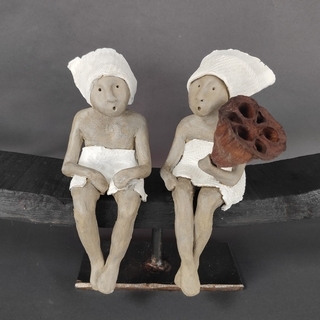
FOURMY Bérénice
Born in 1975, Bérénice Fourmy has always been drawn to art. As a child, she recalls being intrigued by the sacred medieval paintings in the small church of her village; she was mesmerized by them. It was only natural, then, that a few years later, she chose to pursue studies in Art History, specializing in medieval wall paintings. In 2002, she published a book titled "Seeing and Believing: Medieval Wall Paintings in Touraine."
Very hands-on, Bérénice enjoys working with stone and any materials she has at her disposal. So, it was only natural for her to simultaneously take evening classes in a ceramics workshop in Touraine and then in the Vosges.
Gradually, clay began to take up more and more space in her daily life until she fully devoted herself to it in 2008. At first, faces emerged amidst other materials. Bérénice enjoys combining clay with other substances; they enrich and elevate each other while maintaining the sobriety and purity of the sacred images that nourished the artist in her youth. The softness of the lines and subjects reflects a desire to capture the essence; the color palette is restricted, with clay predominating, and the message emerges. Recently, bodies have taken shape, supporting the unique expression of faces marked by astonishment; they perch on supports in perfect harmony with the characters, adding even more lightness. Bérénice Fourmy's sculptures are enhanced by the combination of different materials and a simple wax patina, foregoing glaze to return to the truth of bare clay.
Influenced by her stay in Tahiti for a few years, Bérénice now enriches her works with elements of nature provided by the islands (coconuts, shells, corals...), always ensuring to maintain the simplicity and authenticity of these characters.
Discover 2024 exhibtion
Bérénice Fourmy : The gallery's words:
Bérénice contacted me in early 2024 to present her work. Initially, I discovered the photos attached to the email, and it was love at first sight. I appreciated the simplicity, the earth kept in its natural state, the monochrome palette without any frills, and the underlying questioning. These little characters perched above a world full of questions sometimes seemed surprised, other times amazed, or even worried, but always enveloped in great gentleness and benevolence. We then spoke directly, and I appreciated the energy emanating from the artist; her work reflected her. I am delighted to share with you this lovely find that undoubtedly will also stir your emotions. -
GUERRIN Anne
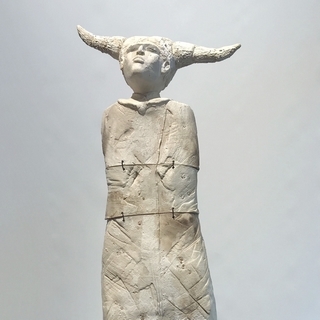
Initially a vital attraction for the earth. As a farmer's daughter, born in the country, Anne Guerrin has been touching it since she was a child, touching it , breathing it, triturating, a vital need that has never ceased to inhabit her. After several moves it is in the beautiful setting of the natural park of Upper Languedoc, where the natural elements express their strength and are conducive to creation that she decided to settle and install her studio.
The "Sages" are universal beings who have gone through time, there is in them something that is of the order of ancestral memory. They are born from the path of a life, an interest in the sacred, this one mani-festing itself in several forms, rites, symbols, myths, readings ... the observation of the man placed at the center of everything. Those who wear skirts or dresses around the world and who attract his attention are religious but also some butoh dancers.
Anne Guerrin : The words of the gallery
I met Anne in 2014, she had commitments that did not allow us, at that time, to collaborate. At the end of 2019 the artist, freed from her commitments, gets back in touch with a work that asserts itself, even more charismatic characters, a universe that seduces me.
The works speak of breaks, spirituality, transversality, an approach that seduces me. -
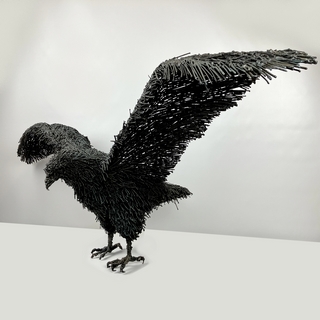
HALFTERMEYER Hellen
Biography of Hellen Halftermeyer: Innovative Sculptor and Painter
Discover Hellen Halftermeyer, a Talented Artist in Wire Sculpture and Painting
Hellen Halftermeyer is a versatile and innovative artist, renowned for her captivating wire sculptures and her prowess in painting. Her unique sculptural works invite us to explore shapes and volumes that are not immediately apparent to the eye. It is only by hanging or mounting her sculptures on the wall that their true essence takes shape, offering a new perspective and dimension to the surrounding space.
Art That Invites Reflection
Hellen Halftermeyer's wire sculptures stand out for their ability to engage the viewer in active visual interaction. Each piece, crafted with meticulous precision, projects shadows and forms that invite discovery and personal interpretation, thus enriching the artistic experience. Her expressive work is a natural extension of her established painting career, where she has always sought to push the boundaries of traditional mediums.
A Rich and Diverse Artistic Career
Before making her mark in the world of wire sculpture, Hellen Halftermeyer gained a solid reputation as a painter. Her transition to sculpture was driven by a desire to explore new forms of expression and to manifest her creative ideas in three-dimensional space. Her sculptures and paintings are present in several private and public collections, and she has been recognized in numerous art fairs and international exhibitions.
Contributions and Recognitions
In addition to her artistic achievements, Hellen Halftermeyer is actively involved in the artistic community, sharing her expertise with young artists and participating in collaborative projects aimed at promoting art and creativity. Her commitment to art extends beyond her own creations; she is also a staunch supporter of initiatives that facilitate access to art for everyone.
Visit the Gallery for More Discoveries
To discover the fascinating works of Hellen Halftermeyer, we invite you to visit our online gallery where you can explore her complete collection of wire sculptures and paintings. Each work is an invitation to rethink the way we perceive art and the space around us.
-
LAVERI Giorgio
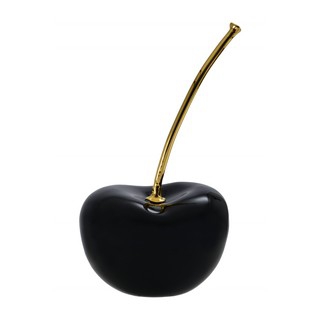
Giorgio Laveri, is an Italian artist already present in many museums, a consecration of more than 45 years of artistic life. Giorgio was born in 1950 in Savona. Actor, assistant director, stage assistant, director, he directed his first film in 1978. Giorgio Laveri is a passionate person who has always given without counting. Generous, the human remains his priority. Very young he discovered ceramics by one of the masters of the discipline: Lucio Fontana who introduced him to what would become his great passion.
Giorgio has a magnificent memory of this period of his life, following in the footsteps of the great masters, feeding on them and paying tribute to them, nothing more beautiful for the artist.
Giorgio remained the multidisciplinary artist of his early days, linking cinema, theatre, painting and ceramics. Since 1974 he has written and directed 11 films and more than 19 plays, including the "Mariage Bet", winner of the Critics' Prize at the "Cinema at Home" of the Rome Film Festival.
In 1990, he went further in his research by creating his first play on the theme "Ceramics - Light - Movement", in which "actors and ceramics interact on stage to create a luminous choreography".
In 1993, he joined the French group Art mobil with whom he planned a series of events in Italy and France, such as the signing with Patrick Moya and Véronique Champollion of the Manifesto of the Mediterranean Artistic Movement, always in evolution.
In 1996, he founded the Department of Mental Health of Genoa, "II Giardino del Mago" with whom he produced a series of works related to theatre and experimental cinema.
In total, there are more than 200 events organized between cinema, theatre, shows and exhibitions.
In 2017 Italy pays tribute to him with an exhibition of exceptional scope.
Giorgio Laveri : The gallery's words
I discovered "The lipstick" of Giorgio on a show in Paris in 2012, This remarkable work, hid an artist of great sensitivity to the atypical course. I met Giogio a few hours later on the stand and left with his works. This confidence given spontaneously touched me a lot. A few years have allowed us to know each other better and to find as much pleasure working together. Giorgio offers contemporary works, objects of life that take meaning and life in his hands.
2022, exibition -
MIROGI
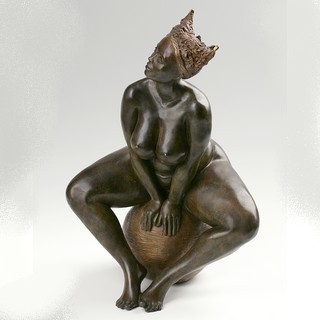
Mirogi practiced as a physiotherapist and osteopath, which allowed her to perfect her knowledge of anatomy. An incredible combination of circumstances would change her career path when she discovered Annick Aublet's studio in 1999. Mirogi then worked days and nights to record years of experience as a physiotherapist. The body, she controls it, she just has to let go of her perception of femininity.
The artist works from living models in the studio and is accustomed to finishing the pieces at home, especially the hands and faces that require a lot of attention to detail.
Mirogi creates finished works where the patinas perfectly reflect the play of light on the bodies. Mirogi is an artist with an assertive style, exhibited in the most prestigious galleries. Many of her bronzes have been included in beautiful collections in France and abroad.
Mirogi : The gallery's words
Mirogi's sculptures were presented to me by an artist's agent. In addition to the aesthetic aspect of his work, I appreciated the postures and the knowledge of the body. Mirogi's works are timeless, we fully feel the femininity of her subjects and their fragility. -
SUTTER Philippe
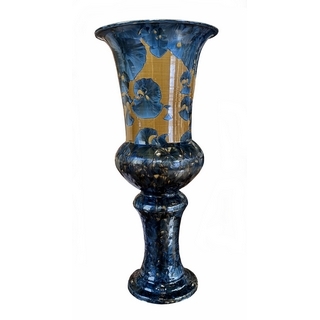
Philippe Sutter pays homage to life, to love and to loved ones, to beauty and its universality. He magnifies emotions, eliciting their expression and opening a breach in our visceral darkness to access the light. Beauty of the soul, beauty of being, beauty of self, its quest brings out the deepest essence of harmony, fullness and spirituality in each of us. The Medici vase becomes the revealing symbol of the link: the foot anchored in the earth, the heart a true alcove of feelings and the open bell turned towards the celestial, all in perfect alignment finds a salutary balance lifting us towards the light. For Philippe, everything is vibratory: words written on paper, interwoven sounds that give rhythm to his gestures, emotions that nourish his work. The artist searches endlessly for the perfect gesture that will reveal the intrinsic link between the 4 elements in a sublimated sensory vibration.From the clay he extracts porcelain, from the crystallised enamels light, and this symphony of materials goes so far as to reveal the mirage of crystal and its voluptuousness. There are no more than 15 artists in the world who have mastered this technique of fire, which links them to the material. Philippe Sutter has drawn on techniques, encounters, literature and philosophy over and over again."From clay we make a pot, but it is the emptiness inside that holds what we want" Lao Tzu. As we lean over this pot, this crater, this circular symbol of contemporaneity, we might hear Plato, Socrates, La Boétie, Voltaire or Diderot whispering a few thoughts to us.
Philippe Sutter : The gallery's words
Philippe arrived at the gallery accompanied by Sophie Bassot, his painter friend, who had come to drop off the works in her exhibition. He placed the Medici vase on the desk to show me his work, and it was at that precise moment that emotion overcame me, silently telling me to put my hands on it - the object had become a work of art. I gently caressed the heart, in an almost religious way. The attraction was intense, and as someone who has never presented an 'object' in the gallery, I couldn't bring myself to let it leave. This same intimacy was shared 2 hours later by a collector who, as soon as he crossed the threshold, also entered this moment suspended in time, the meeting had taken place, and it is now part of his collection.Until this unexpected meeting, I didn't know Philippe Sutter, so we reversed the order of things, and sometimes that's essential. Philippe's extreme sensitivity and sincerity, combined with his passion, make him a generous person with a captivating eloquence when it comes to talking about the Medicis. -
ZANAGA Claudia
Claudia Zanaga
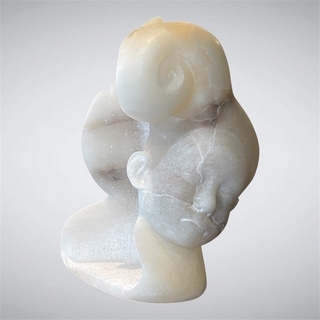
Born in Padua in 1993, Claudia Zanaga is emerging as one of the most promising voices of contemporary European sculpture. Trained at the Academy of Fine Arts in Venice and later awarded a Master's Degree in Sculpture from the Academy of Fine Arts of Carrara in 2021, she has developed a body of work deeply rooted in the tradition of stone carving while addressing some of the most pressing questions of our contemporary world.
Based in Carrara, one of the historic centers of sculptural practice, Claudia Zanaga has established an intimate relationship with stone that extends far beyond technical mastery. Marble, alabaster, and other mineral materials become vehicles for reflections on the human condition, the transformations of living beings, and the ongoing evolution of society. Her work is grounded in a dialogue with matter itself, embracing both its physical presence and its capacity to embody symbolic and narrative dimensions.
At the heart of Zanaga's artistic research lie themes such as identity, migration, metamorphosis, and belonging. Her sculptures often evoke enigmatic presences situated between reality and imagination. Through poetic and timeless forms, she explores the challenges and uncertainties of a generation confronted with environmental, cultural, and social transformations. Her work invites viewers to reflect on the relationships that connect human beings to one another, to nature, and to the broader living world.
Anthropological inquiry plays a central role in her practice. Currently pursuing studies in Cultural Anthropology at Ca' Foscari University in Venice, Zanaga enriches her artistic research through an in-depth exploration of collective memory, cultural transmission, and societal change. This intellectual foundation informs works that transcend representation and become spaces for contemplation, dialogue, and reflection.
A distinctive aspect of her work is its engagement with notions of transformation and the post-human condition. Her sculptures frequently suggest processes of adaptation, mutation, and renewal. Rather than illustrating these ideas directly, she creates evocative visual narratives in which fragility and resilience coexist. Through these forms, she reflects on humanity's capacity to evolve and reinvent itself in response to changing environments and new realities.
Over the past years, Claudia Zanaga has built an increasingly international career through participation in numerous sculpture symposiums, artist residencies, and exhibitions across Europe and beyond. Her work has been presented in France, Spain, Switzerland, Germany, Croatia, Turkey, Egypt, Luxembourg, and Italy. These experiences have contributed to a practice shaped by travel, cultural exchange, and encounters with diverse communities and landscapes.
Recognized early in her career through awards and competitions dedicated to sculpture, Zanaga continues to pursue an ambitious artistic path that combines technical excellence with conceptual depth. Her mastery of direct carving reveals a profound understanding of stone, while the sensitivity of her formal language allows her to address universal themes with remarkable subtlety and emotional resonance.
Through her sculptures, Claudia Zanaga invites viewers to slow down, observe, and reconsider their relationship with time, memory, and the living world. Her work stands at the intersection of the great Italian sculptural tradition and contemporary concerns, demonstrating how sculpture remains a powerful medium for exploring the complexities of our present and imagining possible futures.
Presented by Galerie Bouillon d'Art in Bordeaux, Claudia Zanaga represents a new generation of artists for whom sculpture remains a territory of exploration, poetry, and reflection on the future of humanity.